LMI Crane Safety Systems: Load Moment Indicators for Saudi Cranes, Excavators and Manlifts
About This Solution
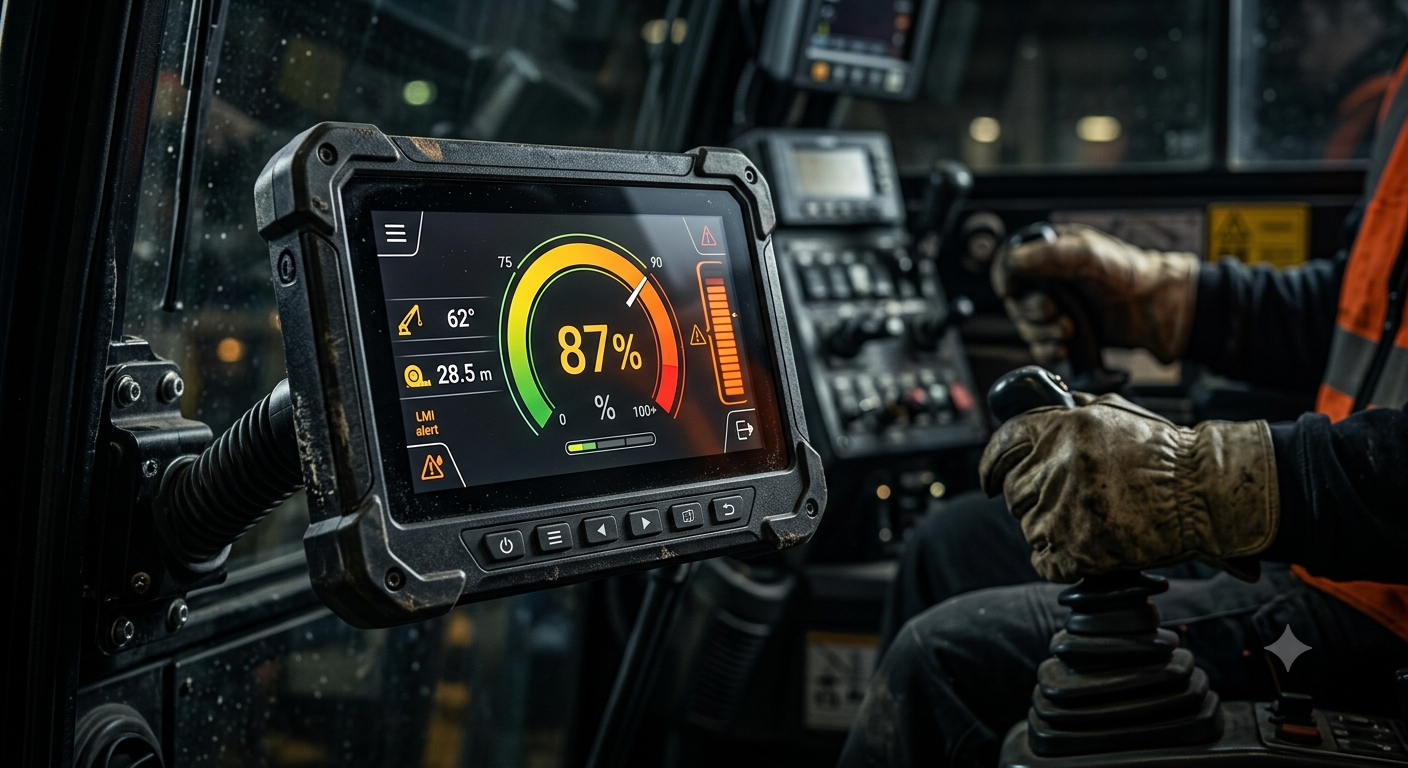
A Load Moment Indicator (LMI) continuously compares a crane's actual load with its rated capacity at the current boom angle and radius, warns the operator at 90%, and automatically restricts motion at 100% — so an overload is stopped before it becomes a tip-over. SNTech supplies EN 13849 and AS 1418.5-certified LMI systems for cranes, excavators and manlifts from Dhahran, with black-box logging and remote monitoring through the SNTech cloud.
Industries That Use This Solution
Complete Feature Set
- 1 Real-time load, boom angle, and working radius monitoring
- 2 Automatic crane motion restriction at 100% rated capacity
- 3 Warning alerts at 90% load threshold with audible alarm
- 4 Anti-two-block & anti-collision systems
- 5 Black-box data logging for incident analysis & compliance
- 6 EN 13849 & AS 1418.5 certified
- 7 Compatible with all major crane brands (Liebherr, Manitowoc, XCMG, SANY)
- 8 Display unit with 7" colour touchscreen
- 9 Manlift & scissor lift load protection systems
- 10 Remote monitoring via SNTech cloud platform
What is a Load Moment Indicator, and what does it actually prevent?
An LMI — also called a Rated Capacity Limiter (RCL) or Rated Capacity Indicator (RCI) — prevents the most catastrophic failure in lifting: overload collapse and tip-over. It continuously measures load weight, boom angle, boom length and radius, and compares them with the rated capacity for the crane's configuration at that moment. At 90% of rated capacity it gives the operator an audible and visual warning; at 100% it automatically restricts further boom extension or hoisting, so the crane physically cannot complete a lift that would exceed its rated capacity.
Saudi Aramco's lifting operations standard requires every mobile crane working in Aramco facilities to have a functioning, calibrated LMI — a hard stop: cranes without one are not permitted to operate. Read the full LMI and ARAMCO guide.
"The LMI systems on our crane fleet have been transformative. We've had zero overloading incidents since installation, and the real-time cloud dashboard gives us complete visibility." — Khalid Bin-Saeed, Lifting Operations Supervisor, SWCC Projects
EN 13849 and AS 1418.5: what the certification actually means
SNTech's LMI systems are certified to both standards, and they cover different things. EN 13849 is a functional-safety standard: it governs how the LMI's safety-related control circuitry is designed, so that a single component failure cannot silently disable the overload protection. AS 1418.5 is a crane-specific design standard that defines the rated-capacity limiting behaviour itself — at what load percentage warnings must trigger and when motion must be restricted.
Together they mean an LMI is not just an accurate load gauge; it is a system engineered so the safety function keeps working even when something inside it fails.
Which LMI fits which machine?
An LMI built for a tower crane does not transfer directly to an excavator, because what makes each machine unstable is different:
- LMI-CR — lattice-boom, telescopic and tower cranes. Load accuracy of ±1%, boom-angle sensing to ±0.1°, anti-two-block protection and a 7" colour touchscreen: the classic rated-capacity limiter.
- LMI-EX — hydraulic excavators and material handlers. Calculates the real-time stability margin as the machine slews and extends, because an excavator's tip-over risk changes continuously with boom, stick and bucket position rather than following one static load table.
- LMI-ML — aerial work platforms, manlifts and scissor lifts. A platform load cell, dual-axis inclinometer and automatic platform lock-out protect against the two failures specific to elevated platforms: basket overload and working on an excessive slope.
An LMI is not a one-time purchase
Load cells and angle sensors drift with vibration, temperature cycling and wear. SNTech recommends calibration verification at commissioning, after any boom or rigging configuration change, and at least every six months after that — more often for cranes working through Saudi Arabia's summer heat, where thermal cycling accelerates drift. The black-box event logger keeps a full history of load, angle and radius readings, which makes a drifting sensor visible before it causes a missed overload.
Any configuration change — a different jib length, added counterweight, new rigging — also changes the load chart the LMI validates against. SNTech's LMI can select the load chart automatically, but that still depends on the configuration being entered correctly, which is why SNTech includes on-site operator briefing in every deployment rather than treating it as an extra.
LMI data can also travel with the rest of your fleet data: SNTech's R56L heavy-asset tracker carries LMI readings alongside location, fuel and CAN-bus telemetry into the fleet management platform.
LMI vs a simple load limit switch: what is the difference?
Both react to weight, but only one knows whether the crane can safely hold that weight in its current position:
| Simple overload alarm / load limit switch | Load Moment Indicator (LMI) | |
|---|---|---|
| What it measures | Load weight against one fixed threshold | Load weight, boom angle, boom length and radius against the rated capacity for the current configuration |
| How it responds | A single warning or cut-out at the fixed limit | Two stages: warning at 90% of rated capacity, automatic motion restriction at 100% |
| Tip-over as the boom moves out | Not detected — the same load becomes unsafe at a longer radius without crossing the fixed limit | Detected continuously, because rated capacity is recalculated as angle and radius change |
| If a component fails | Depends on the device — not necessarily built to a functional-safety standard | Designed to EN 13849 so a single failure cannot silently disable protection |
| Records | Typically none | Black-box log of load, angle and radius for incident analysis and compliance |
A fixed load limit only means something when the machine's geometry never changes. On any crane with a boom, the safe load changes with every change of angle and radius — which is exactly what an LMI tracks and a limit switch cannot.
Where LMI is used
Construction
Crane LMI to prevent overloading, paired with PWAS and GPS fleet tracking — SNTech's construction clients report up to 40% fewer site incidents. Construction sector →
Oil & gas
Every mobile crane in Aramco facilities must have a functioning, calibrated LMI; SNTech's excavator and manlift variants are also marked ARAMCO-compliant. Oil & gas sector →
Utilities & infrastructure
SWCC Projects runs SNTech LMI across its crane fleet and reports zero overloading incidents since installation, with full visibility through the cloud dashboard.
Ports & material handling
Overload and tip-over protection for reach stackers and material handlers, where load and reach change on every lift. Ports sector →
Frequently Asked Questions
How does a Load Moment Indicator prevent crane accidents?
An LMI continuously monitors load weight, boom angle, and working radius against the crane's rated capacity. It warns the operator at 90% of rated load and automatically restricts further motion at 100%, stopping an overload before it becomes a tip-over. SNTech's LMI systems are certified to EN 13849 and AS 1418.5.
What is the difference between an LMI and a load limit switch?
A load limit switch typically reacts to weight at one fixed threshold. An LMI calculates the actual load moment — weight combined with boom angle and radius — continuously, against the rated capacity for the crane's current configuration. That is why it catches a tip-over risk as the boom extends, which a fixed limit would miss.
Is an LMI required on ARAMCO sites?
For mobile cranes, yes. Saudi Aramco's lifting operations standard requires every mobile crane operating in Aramco facilities to have a functioning, calibrated LMI, and cranes without one are not permitted to operate.
What do EN 13849 and AS 1418.5 certify?
EN 13849 is a functional-safety standard for how the LMI's safety circuitry is designed, so a single component failure cannot silently disable overload protection. AS 1418.5 is a crane design standard that defines the rated-capacity limiting behaviour — when warnings trigger and when motion is restricted. SNTech's LMI is certified to both.
How often should an LMI be calibrated?
SNTech recommends calibration verification at commissioning, after any boom or rigging configuration change, and at least every six months — more often for cranes working through Saudi summer heat, where thermal cycling accelerates sensor drift.
Which crane brands does SNTech's LMI support?
SNTech's LMI is compatible with major crane brands including Liebherr, Manitowoc, XCMG and SANY, across lattice-boom, telescopic and tower cranes. Because each kit is specified per machine type, confirm your exact make and model with SNTech's team when requesting a quote.
Zero overloading incidents since installation
That is SWCC Projects' result across its crane fleet. Talk to SNTech's Dhahran team to specify the right LMI kit for each of your machines.
Specify Your LMI System →