Digital Twin Platform for Saudi Oil & Gas, Construction and Smart Facilities
About This Solution
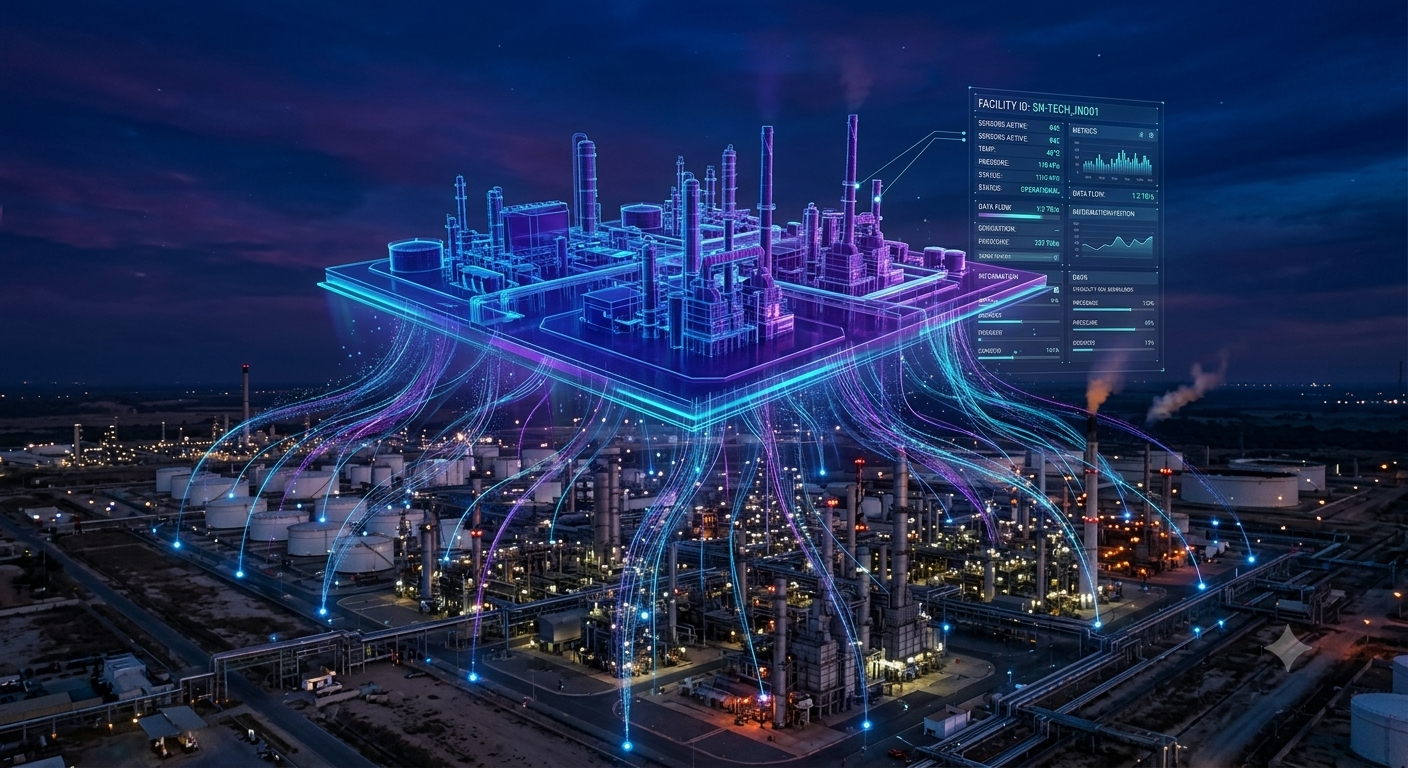
A digital twin is a live virtual replica of a physical asset — a compressor train, a crane fleet, a building — fed with real-time sensor data, so you can see its current state, predict failures and test changes before making them. SNTech builds twins on top of the SCADA, DCS, BMS and IoT data you already have, and on one 30-crane fleet in Jubail Industrial City the twin predicted 4 hydraulic failures in its first 3 months, avoiding an estimated SAR 2.4M in unplanned downtime.
Industries That Use This Solution
Complete Feature Set
- 1 3D facility modelling from BIM, CAD, or site scans
- 2 Real-time IoT sensor integration (temperature, pressure, power)
- 3 Predictive maintenance engine with ML anomaly detection
- 4 Energy consumption monitoring & optimisation dashboards
- 5 Remote operations control & virtual walkthroughs
- 6 Asset lifecycle management & maintenance scheduling
- 7 Integration with SCADA, DCS, and BMS systems
- 8 AR/VR interface for field technicians
- 9 Incident simulation & emergency response planning
- 10 Cloud-hosted or on-premise deployment options
What a digital twin is — and what it is not
A digital twin combines three things: live equipment telemetry (pressure, temperature, vibration, load), the asset's maintenance history (what broke, when, and what fixed it), and an asset model (its physical configuration — boom length, rated capacity, installation date — plus a 3D model built from BIM, CAD or site scans). Put together, the twin mirrors the asset's current state and can compare it against the patterns that preceded past failures.
It does not "guess" that a component will fail. When a live trend — a vibration signature, a temperature curve, a pressure differential — starts tracking a known failure pattern instead of normal operation, the platform raises an alert with an estimated time-to-failure window, giving maintenance teams days rather than minutes of warning. The longer the twin runs on an asset, the more accurate that window becomes.
Real-world result: a 30-crane fleet in Jubail
A major construction contractor deployed SNTech's digital twin across its 30-crane fleet in Jubail Industrial City. Within 3 months the system had predicted 4 hydraulic failures before they occurred, preventing an estimated SAR 2.4M in unplanned downtime and avoiding potential safety incidents. Read the full digital twin guide.
Start with one asset class, not the whole site
SNTech recommends starting on a single high-value, high-downtime-cost asset class — a crane fleet, a compressor train, or a fleet of generators — rather than an entire facility. That keeps the data-integration work bounded, produces a measurable downtime-avoidance number within the first quarter, and builds the confidence to extend the twin across the site.
Most Saudi industrial sites already generate the telemetry and maintenance history a twin needs, as a by-product of existing SCADA and CMMS systems. The twin's job is to connect them into one model, not to demand a new sensor network from scratch.
SCADA, DCS and BMS integration in practice
"Integrates with SCADA" is easy to claim and hard to deliver, because every site's SCADA and DCS configuration is different — different tag naming, different historians, different segmentation between OT and IT networks. SNTech's integration starts with a tag-mapping exercise: which existing tags already cover what the twin needs, and which gaps genuinely require a new sensor. For buildings, the twin pulls HVAC, lighting and energy data through the BACnet or Modbus interfaces the BMS already exposes. Connecting OT data to a twin should respect that segmentation — see OT cybersecurity and IEC 62443.
Finally, a twin that sits with IT but never reaches the maintenance team delivers none of its value. SNTech's deployments include a handover phase aimed at operations and maintenance teams, so alerts land with the people who can schedule the intervention.
Digital twin vs SCADA screens vs a 3D model: what is the difference?
The terms get used interchangeably, but they do different jobs — and a twin builds on the other two rather than replacing them:
| SCADA / BMS screens | Static 3D or BIM model | Digital twin | |
|---|---|---|---|
| Shows | Live process values and alarms | Geometry and layout | Live state on the 3D model, plus history and predictions |
| Uses maintenance history | No | No | Yes — compared with live trends |
| Predicts failures | No — alarms when a limit is crossed | No | Yes — with an estimated time-to-failure window |
| Simulates changes | No | Layout only | Yes — operational scenarios and incident response |
| Replaces the others? | — | — | No — it sits on top of SCADA, DCS and BMS data |
If you only need to operate a process in real time, SCADA does that job. A twin earns its place when downtime is expensive enough that days of warning, and the ability to test changes virtually first, are worth paying for.
Where digital twins are used
Oil & gas
Compressor stations, pipelines and generator fleets, built on existing SCADA and DCS tags. Oil & gas sector →
Construction
Crane fleets — the source of the Jubail result — where one hydraulic failure stops a lift programme. Construction sector →
Smart facilities & campuses
Plants, warehouses and campuses, with energy monitoring and optimisation from BMS data, virtual walkthroughs and remote operations.
Emergency planning
Incident simulation and emergency response planning on the twin before anything happens on site, with AR/VR views for field technicians.
Frequently Asked Questions
What is a digital twin?
A live virtual replica of a physical asset, process or facility that receives real-time sensor data, so it mirrors the asset's current state. Combined with maintenance history and an asset model, it can predict failures and simulate changes before they are made on the real asset.
How is a digital twin different from SCADA?
SCADA shows live process values and raises alarms when limits are crossed, so operators can run the process. A digital twin sits on top of that data, adds maintenance history and an asset model, and predicts failures days in advance and simulates scenarios. It builds on SCADA rather than replacing it.
What data do we need to start?
Three streams: equipment telemetry (pressure, temperature, vibration, load), maintenance history (what broke, when and what fixed it), and an asset model (physical configuration and specifications). Most industrial sites already have the first two in their SCADA and CMMS systems.
Do we need to install new sensors?
Usually only to fill gaps. SNTech's integration starts by mapping which existing SCADA tags or BMS points already cover the parameters the twin needs; new sensors are added only where a genuine gap exists.
Where should a digital twin project start?
On one high-value, high-downtime-cost asset class — a crane fleet, a compressor train or a fleet of generators. That keeps integration bounded and produces a measurable downtime-avoidance result within the first quarter.
Can the platform run on-premise?
Yes. SNTech's digital twin can be cloud-hosted or deployed on-premise, depending on your data and network requirements.
Pick the asset class to pilot
Tell SNTech's team which assets cost you most when they stop. We'll scope a pilot twin on the data you already collect.
Scope a Digital Twin Pilot →