AI-Powered GPS Fleet Management for Saudi Arabia's Commercial Fleets
About This Solution
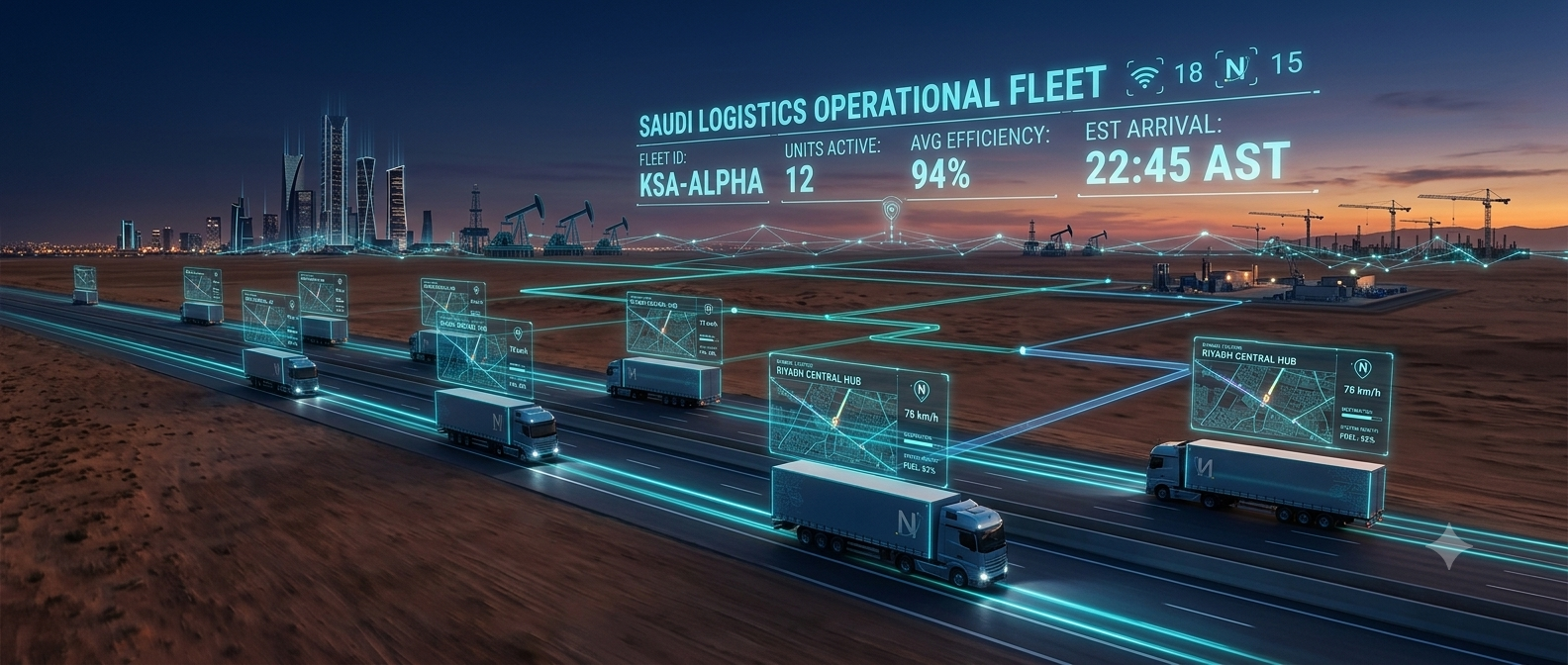
SNTech's fleet management platform combines live GPS tracking with the three things a basic tracker doesn't do: AI driver-behaviour scoring that targets harsh acceleration, speeding and idling; predictive maintenance alerts from vehicle telemetry; and automated MOT IVMS compliance reporting. Supported from Dhahran and used by 40+ clients across Saudi Arabia — including a 120-vehicle logistics fleet that cut fuel costs 38% in 12 months.
Industries That Use This Solution
Complete Feature Set
- 1 Real-time GPS tracking & geofencing with live map view
- 2 AI-powered driver behavior monitoring & safety scoring
- 3 Fuel consumption tracking & theft detection
- 4 Predictive maintenance alerts (ML-powered diagnostics)
- 5 Route optimization with AI-driven algorithms
- 6 Fleet analytics & reporting dashboards
- 7 Mobile app for drivers and managers (iOS & Android)
- 8 Integration with ERP systems (SAP, Oracle)
- 9 MOT-compliant IVMS for all vehicle types
- 10 Automated compliance reports for Saudi government submission
What is AI-powered fleet management, and why does it matter in Saudi Arabia?
Fleet software that only shows where a vehicle is right now is table stakes — every provider does that. What actually moves cost and compliance for a Saudi fleet is combining live location with three layers most basic trackers don't have: driver-behaviour scoring that catches harsh acceleration, speeding and idling before they show up in the fuel bill; predictive maintenance alerts that flag a failing component before it strands a vehicle mid-route; and IVMS reporting built for Ministry of Transport requirements, so fleet managers aren't running a second system just to stay compliant.
SNTech's platform does all three from one dashboard. Every driver is scored from 1 to 100, drivers and managers get iOS and Android apps — including an Arabic-language driver app — and fleet data integrates with ERP systems such as SAP and Oracle.
How much does it actually save? The 38% case study in full
In a documented deployment, a Saudi 3PL provider running 120 vehicles on Riyadh, Dammam and Jeddah routes — previously spending more than SAR 8 million a year on fuel — recorded a 38% fuel-cost reduction after 12 months on SNTech's platform. That is SAR 3.04 million saved, alongside a 67% reduction in harsh driving events, zero theft incidents, and MOT IVMS compliance achieved along the way.
The mechanism is not mysterious. Harsh acceleration accounts for up to 15% excess fuel consumption, speeding adds another 8–12%, and unnecessary idling can waste 20% of fuel on Saudi construction sites. Driver scoring targets exactly those behaviours, which is why the saving shows up in the fuel bill rather than only in a report.
Results vary, and we would rather explain why than round up. Fleets with little prior visibility into driver behaviour see the largest gains; long-haul intercity routes have more to optimise than dense urban last-mile routes; and heavy trucks save more in absolute terms than light vehicles. For planning, SNTech's ROI model deliberately assumes 30% fuel and 15% maintenance savings — below the documented result. Read the full case-study breakdown.
Another logistics group, running 200 vehicles, rolled the platform out across its operation in six weeks and reported a 43% drop in fuel costs in the first quarter: "The Arabic-language driver app and automated MOT compliance reports alone saved us thousands of hours of admin." — Mohammed Al-Harbi, VP Operations, Leading Saudi Logistics Group.
Which tracker goes in each vehicle?
The platform runs on SNTech's own tracker range, matched to the asset rather than one-size-fits-all. Passenger and light commercial vehicles with OBD-II take the plug-in S21L; trucks and buses take the hardwired, IP67-rated R12L; cranes, excavators and generators use the R56L for fuel-sensor, LMI and CAN-bus telemetry; and assets with no power supply of their own — trailers, containers, portable generators — carry the battery-powered W18L tag. Compare the four tracker models.
Basic GPS tracker vs IVMS compliance vs full fleet management: which do you need?
"GPS tracking" gets used loosely. There are really three tiers, and the cheapest one that meets your needs is the right one:
| Basic GPS tracker | IVMS compliance module | Full fleet management platform | |
|---|---|---|---|
| Answers | Where is the vehicle? | Is my fleet meeting the MOT requirement? | Why is this vehicle costing more than it should, and what do I do about it? |
| Live map tracking | Yes | No | Yes |
| MOT IVMS data capture, 12-month storage & reporting | Usually not formatted for MOT submission | Yes | Yes |
| Driver behaviour scoring | No | Captured for compliance reporting | Yes — every driver scored 1–100 |
| Fuel monitoring, route optimisation, predictive maintenance | No | No | Yes |
| Best fit | Location visibility only, with no compliance obligation | Under roughly 20 vehicles on fixed local routes | Larger fleets, or any fleet on variable long-haul routes |
Most SNTech clients start with IVMS compliance and expand into the full platform within their first year. Both run on the same hardware and data stream, so upgrading does not mean reinstalling. Read the full MOT IVMS compliance guide.
How each sector uses fleet management
Logistics
Driver scoring, fuel monitoring and route optimisation across long intercity routes — the sector behind the documented 38% case study. Logistics sector →
Construction
Heavy-equipment GPS tracking and utilisation monitoring, driver behaviour analytics and IVMS compliance — often on the same site as PWAS and crane LMI. Construction sector →
Oil & gas
Contractor fleet management, so contractor vehicles meet site compliance requirements without separate safety infrastructure. Oil & gas sector →
Car rental
SNTech car-rental clients have measured a 40% reduction in vehicle theft and unauthorised use, plus automated mileage reporting that removes manual reconciliation. Car rental sector →
Government
Government vehicle fleets, public-transport GPS tracking and IVMS integration for government mandates, consolidated onto one platform instead of one system per department. Government sector →
Healthcare
Ambulance GPS tracking with dispatch optimisation — sending the nearest available ambulance rather than the nearest scheduled one cuts average response time by up to 20%. Healthcare sector →
Frequently Asked Questions
How does GPS fleet management reduce costs in Saudi Arabia?
It combines real-time GPS tracking with AI driver-behaviour scoring to cut the three biggest waste sources: harsh acceleration, speeding, and idling. SNTech clients see up to 20% lower operating costs, and in a documented 120-vehicle logistics deployment, fuel costs fell 38% over 12 months — SAR 3.04 million saved.
What does MOT IVMS compliance require from my fleet?
Commercial fleets need an in-vehicle monitoring system that records vehicle speed at 1-second intervals, time-stamped GPS coordinates, harsh braking events, speeding violations, and journey start and end times, keeps that data for 12 months, and can report it to the Traffic Authority on request. SNTech generates the required reports automatically from the same data used for driver scoring.
Does a small fleet need the full fleet management platform?
Not always. For a fleet under roughly 20 vehicles on fixed local routes, SNTech's IVMS compliance module on its own is often genuinely sufficient. Larger fleets and those on variable long-haul routes usually recover the cost of the full platform through fuel and maintenance savings — and because both run on the same hardware, you can start with compliance and upgrade later.
How long does deployment take?
A 200-vehicle logistics group rolled SNTech's platform out across its whole operation in six weeks. The timeline for your fleet depends on vehicle count, the tracker models involved, and any ERP or TMS integration.
Can it integrate with our ERP or transport management system?
Yes. The platform integrates with ERP systems including SAP and Oracle, and SNTech trackers provide an open API so fleet data can flow into your own systems. In the 120-vehicle case study, integration with the client's TMS enabled route optimisation.
Related solutions and guides
See how a 120-vehicle fleet cut fuel costs 38%
Get a free assessment from SNTech's Saudi team — we'll show where the fuel and compliance savings are for your vehicles and routes.
Get Your Fleet Assessment →