Drone Inspection, Surveying and Industrial Robotics for Saudi Oil & Gas and Infrastructure
About This Solution
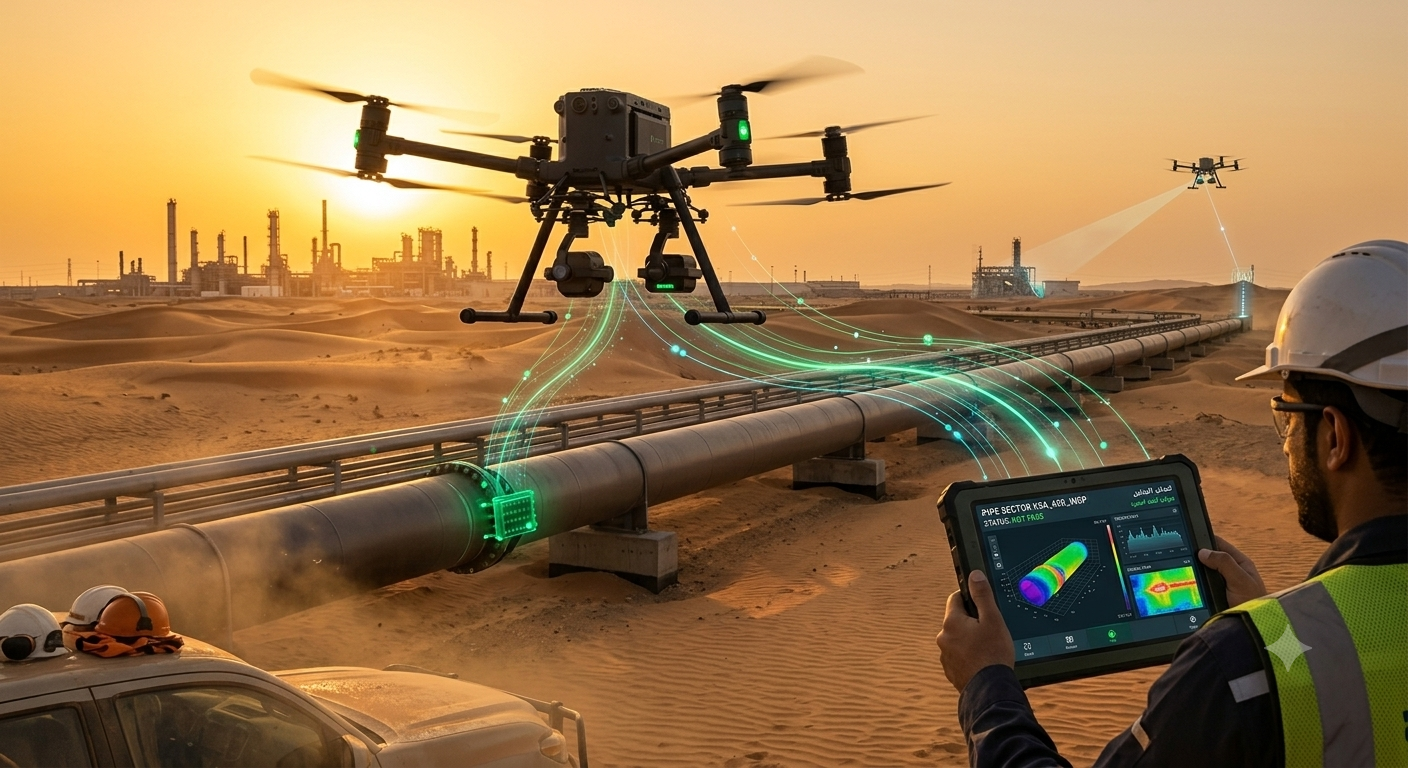
Drones and robots do the inspection work that is dangerous, slow or impossible for people: flying a pipeline corridor, looking inside a tank without anyone entering it, measuring wall thickness from the inside, or sniffing for gas leaks. SNTech supplies and operates drones, crawlers, ROVs and quadruped robots for surveying, NDT inspection, confined-space assessment and leak detection across Saudi oil & gas, construction, utilities and infrastructure — with the data delivered into AI analytics dashboards.
Industries That Use This Solution
Complete Feature Set
- 1 Drone-based topographic surveying, LiDAR mapping & 3D as-built modeling
- 2 Visual & NDT inspection (thermal, ultrasonic, PAUT) for pipelines, tanks & structures
- 3 Autonomous drone operations with AI navigation & BVLOS long-range capability
- 4 Confined space inspection — caged drones for tanks, vessels, boilers & reactors
- 5 Gas emission monitoring with OGI, TDLAS & sniffer sensors for real-time leak detection
- 6 Seismic data collection with geophones & magnetometers for oil & gas exploration
- 7 Quadruped robots for routine inspection of unstructured & hazardous terrain (ATEX-certified)
- 8 ROVs for subsea & live hydrocarbon tank inspection without draining
- 9 Robotic crawlers for tank cleaning & NDT-UT internal wall thickness measurement
- 10 AI-powered analytics dashboards for inspection data, anomaly detection & asset health
Why robotic inspection instead of sending people in
Confined-space entry into a tank, vessel or boiler is one of the most hazardous jobs on an industrial site, and it usually means shutting the asset down, gas-freeing it and staffing a standby team first. A caged drone flies inside and records the condition instead. The same logic applies at height, over long pipeline corridors and in live hydrocarbon tanks: an ROV can inspect a tank without draining it, and a crawler can measure internal wall thickness by ultrasonic testing from inside.
The result is less exposure for people and less downtime for the asset — and because every inspection produces data, the findings feed AI analytics dashboards for anomaly detection and asset-health tracking rather than a one-off report.
Plan for permits as well as flights
Commercial drone flights in Saudi Arabia are regulated by the General Authority of Civil Aviation (GACA), and flights beyond visual line of sight (BVLOS) or near critical facilities need specific approvals. Operating inside an industrial facility also means following the site's own permit-to-work system. Build the approval lead time into the inspection schedule from the start, rather than discovering it the week of the flight.
Which robot for which inspection?
Each platform reaches a different kind of space. Most inspection programmes use more than one:
| Drone | Caged confined-space drone | Crawler | ROV | Quadruped robot | |
|---|---|---|---|---|---|
| Reaches | Heights, structures, corridors and open terrain | Inside tanks, vessels, boilers and reactors | Tank floors and internal walls | Subsea and inside live hydrocarbon tanks | Unstructured and hazardous ground |
| Typical jobs | LiDAR surveys, 3D as-builts, thermal and visual inspection, gas leak detection | Visual condition assessment without human entry | Tank cleaning, NDT-UT wall-thickness measurement | Inspection without draining the tank | Routine inspection rounds (ATEX-certified) |
| Main constraint | GACA approvals, especially for BVLOS | Visual only — no contact measurement | Needs access and a suitable surface | Fluid and visibility conditions | Ground it can traverse |
For exploration work, SNTech also collects seismic data with geophones and magnetometers.
Where drones and robotics are used
Oil & gas
Pipeline and tank inspection, gas-emission monitoring with OGI, TDLAS and sniffer sensors, and seismic data collection for exploration. Oil & gas sector →
Construction
Topographic surveys, LiDAR mapping and 3D as-built models to track progress against design. Construction sector →
Utilities & infrastructure
Thermal and visual inspection of structures, boilers and vessels, with NDT including ultrasonic and PAUT.
Frequently Asked Questions
What can drones inspect on an industrial site?
Pipelines, tanks, structures and open terrain — using visual, thermal and NDT methods (including ultrasonic and PAUT) — plus LiDAR surveying and 3D as-built models, and gas-emission monitoring with OGI, TDLAS and sniffer sensors.
Can a tank be inspected without anyone entering it?
Yes. Caged drones inspect inside tanks, vessels, boilers and reactors, ROVs can inspect live hydrocarbon tanks without draining them, and robotic crawlers measure internal wall thickness with ultrasonic testing.
Do drone flights in Saudi Arabia need approval?
Yes. Commercial drone operations are regulated by the General Authority of Civil Aviation (GACA), and flights beyond visual line of sight or near critical facilities need specific approvals, on top of the site's own permit-to-work system. Plan the approval lead time into the schedule.
What are quadruped robots used for?
Routine inspection rounds over unstructured and hazardous terrain, where wheeled robots or people on foot struggle. SNTech's quadruped robots are ATEX-certified for hazardous areas.
What happens to the inspection data?
It feeds AI-powered analytics dashboards for anomaly detection and asset-health tracking, so each inspection builds a condition history rather than a one-off report.
Related solutions
Scope your next inspection
Tell SNTech what you need inspected and where. We'll recommend the platform and plan the approvals around your schedule.
Plan an Inspection →