RFID Asset Tracking for Saudi Warehouses, Oil & Gas and Healthcare — with BLE and LoRaWAN
About This Solution
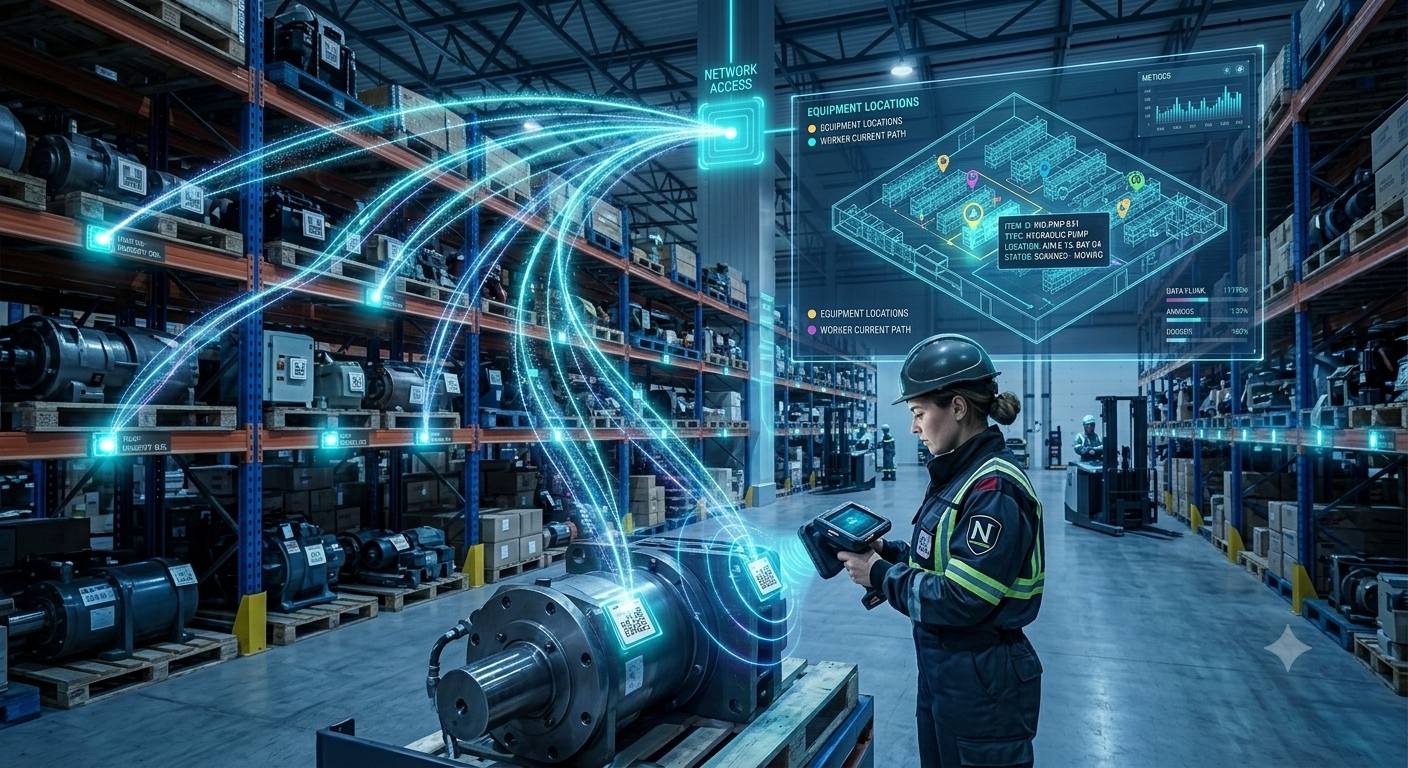
Asset tracking tells you where your tools, equipment and stock are without anyone walking the site with a clipboard. SNTech designs and installs tracking on three technologies — UHF RFID from CHAFON for scan-free inventory, Minew Bluetooth (BLE) gateways and sensors for continuous indoor visibility, and Minew and Tektelic LoRaWAN, including ATEX-certified hardware for hazardous areas — feeding one cloud dashboard that exports to your ERP or WMS.
Industries That Use This Solution
Complete Feature Set
- 1 UHF RFID smart inventory & warehouse automation (CHAFON)
- 2 Real-time asset & equipment tracking with RFID tags
- 3 Bluetooth 5.0 IoT gateways for BLE sensor networks (Minew G1)
- 4 LoRaWAN + 4G gateways for long-range industrial deployments (Minew MG6)
- 5 ATEX-certified LoRaWAN hardware for hazardous environments (Tektelic)
- 6 Equipment on/off status monitoring (Minew MSE01/MSE02 sensors)
- 7 Retail stock management, loss prevention & shelf analytics
- 8 Logistics & supply chain visibility with scan-free item tracking
- 9 Smart city asset management & waste monitoring
- 10 Cloud dashboard with alerts, history, and export to ERP/WMS
What problem does asset tracking actually solve?
The cost of untracked assets is mostly invisible: technicians searching a yard for a tool, a hospital hunting for an infusion pump, a warehouse count that takes a weekend and is wrong by Monday, equipment that walks off site and is only missed at the next audit.
Tracking turns that into data. Every tagged item reports where it is — continuously, or each time it passes a reader — so stock counts become a scan instead of a shutdown, lost-equipment searches become a dashboard lookup, and missing items raise an alert instead of a surprise. Because hours spent searching for equipment are easy to measure before and after, asset tracking is also one of the cleanest industrial IoT investments to prove a return on. Read how SNTech measures IoT ROI.
Read rates depend on the site — plan for it
UHF RFID readers and tags commonly follow the ISO 18000-6C (EPC Gen2) air-interface standard, which is what lets many tags be read at once without line of sight. But real-world read rates depend on the environment as much as the hardware: metal surfaces and liquids interfere with UHF signals, and dense racking creates dead spots. The right tag for a steel tool is not the right tag for a cardboard carton.
That is why a site survey and a read test on your actual assets should come before a full rollout — and why many sites combine technologies: RFID where items pass defined points, BLE where you need continuous indoor presence, and LoRaWAN where assets are spread across a large outdoor site.
RFID vs BLE vs LoRaWAN: which tracking technology fits?
SNTech deploys all three, because each answers a different question about your assets:
| UHF RFID (CHAFON) | Bluetooth BLE (Minew G1) | LoRaWAN (Minew MG6, Tektelic) | |
|---|---|---|---|
| Answers | Did this item pass this point, and what is on this shelf? | Which room or zone is this item in right now? | What is the status of this asset across a large site? |
| Tag power | Passive — no battery in the tag | Battery-powered beacons and sensors | Battery-powered sensors |
| How location is known | When the tag passes a fixed or handheld reader | Continuously, from the nearest gateway | Continuously over long range, at low data rates |
| Best for | Warehouse inventory, retail stock, tool check-in/out, supply chain | Indoor equipment, smart warehousing, healthcare, cold-chain sensors | Outdoor industrial sites, equipment on/off status, smart city, hazardous areas (ATEX) |
| Watch out for | Metal and liquids affect reads; only sees tags near a reader | Needs gateway coverage and battery replacement | Low bandwidth — status and sensor data, not precise positioning |
Most enterprise sites end up with a mix, all feeding the same cloud dashboard with alerts, history and export to ERP or WMS. Compare the CHAFON, Minew and Tektelic hardware.
Where asset tracking is used
Oil & gas
Tool and equipment management across plants and yards, with ATEX-certified Tektelic LoRaWAN gateways for hazardous areas. Oil & gas sector →
Healthcare
Locating hospital equipment in real time, so staff stop searching wards for shared devices. Healthcare sector →
Warehousing & logistics
Smart inventory and scan-free item tracking through the supply chain, from receiving to dispatch. Logistics sector →
Retail & smart city
Retail stock management and loss prevention, plus smart city asset management and waste monitoring over LoRaWAN — alongside electronic shelf labels.
Frequently Asked Questions
Does SNTech offer RFID asset tracking for industrial facilities?
Yes. SNTech's asset tracking uses UHF passive and active RFID tags with fixed and handheld readers, plus BLE and LoRaWAN gateways and sensors, to give real-time visibility of tools, equipment and inventory across oil & gas, construction, manufacturing and healthcare facilities in Saudi Arabia.
Should I use RFID, BLE or LoRaWAN?
Use UHF RFID when you need to know what passed a point or what is on a shelf — inventory, stock and tool check-in. Use BLE for continuous room- or zone-level presence indoors. Use LoRaWAN for status and sensor data across large outdoor or hazardous sites. Many sites combine them.
Does RFID work on metal equipment and liquids?
Metal surfaces and liquids interfere with UHF RFID, so the tag type and placement matter — a tag that reads well on a carton may not read on a steel tool. A site survey and a read test on your real assets before rollout is the reliable way to confirm read rates.
Can asset tracking be used in hazardous areas?
Yes. Tektelic's ATEX-certified LoRaWAN gateway is built for hazardous industrial environments and is deployed in oil & gas, smart metering and industrial manufacturing.
Can tracking data go into our ERP or WMS?
Yes. The cloud dashboard provides alerts and history, and exports data to your ERP or WMS so asset locations and stock levels flow into the systems you already use.
Where does asset tracking pay back fastest?
Where there is a clear baseline to measure against — typically hours spent searching for equipment or the time and error rate of manual stock counts. Those numbers are easy to record before rollout and compare afterwards.
Related solutions and guides
Plan your asset tracking rollout
Tell SNTech's team what you need to track and where. We'll recommend the RFID, BLE and LoRaWAN mix for your site, starting with a read test on your own assets.
Plan My Asset Tracking →